The 2008 machine,rebuilt responsibly.On sports gambling.
A CDO, a volatility index, and a correlation note, assembled out of World Cup
prediction markets — fully collateralized, settling in a regulated stablecoin, resolving
through a decentralized oracle, roughly two hours after the final whistle.
This is the build plan for the most reckless instrument in finance. Engineered so it can't go wrong.
Over the next ten minutes you will rebuild — exactly, brick for brick — the
structured-credit machine that vaporized the global economy in 2008: the bond, the index,
the CDO, the volatility index, the correlation swap. The catch is the collateral.
In 2008 it was American real estate — the safest asset on Earth — wrapped in
30× leverage and a lie. Here it is World Cup prediction markets: the
dumbest-sounding collateral imaginable, fully funded, on-chain, leverage exactly zero, the one
fatal assumption printed in red on the front of the box.
The joke writes itself. Then it compiles. Keep scrolling and decide whether
it's the stupidest thing you've ever seen — or the first honest one.
5 instruments100% collateralized0× leverage1 assumption, in red~2h to settle
On June 11, 2026, the largest sporting event in human history kicks off in Mexico City,
and for the first time, the dominant way a large slice of the world bets on it is not a
bookmaker. It is a prediction market — a venue where you buy a contract that pays one
dollar if a thing happens and zero dollars if it doesn't, at a price that floats between
zero and one hundred cents and is the market's live probability of the thing.
One World Cup contract has turned over $1.6 billion before a single ball was kicked.
Sports are now roughly 39% of the largest venue's volume. Combined monthly volume across
the major venues went from under $5 billion to roughly $24 billion in eight months.
This is, functionally, a parallel derivatives exchange for reality, and it has discovered
sports at the exact moment sports has discovered it.
prediction-market volume · monthlyLIVE
The volume ramp. Nobody planned this; it simply turned out that the market
for "things that will either happen or not happen" is every market.
Everyone trading these contracts is arguing about whether France is overpriced at 16
cents. Everyone trading these contracts is missing what the contract is.
A prediction-market contract is not a bet. It is a fully-collateralized,
transferable, programmable cashflow. This sentence is the entire website.
Everything below is just consequences.
§ II — The atom
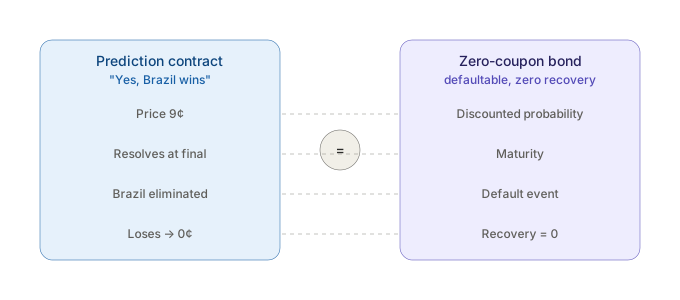
A binary claim is a zero-coupon bond with a coin flip attached
A "Yes" share on Brazil wins the World Cup pays $1 if Brazil wins and $0
otherwise, and trades today at about nine cents. A fixed-income desk would not call that
a bet. They would call it a zero-coupon, zero-recovery bond with a single binary credit
event at maturity, where the credit event is "Brazil fails to win the World Cup," and
they would not be being cute. The payoff structures are identical. The nine cents
decomposes exactly like a bond price. There is a yield, a duration, and a hazard rate,
and the hazard rate is Croatia.
binary claim ≟ zero-coupon bondFIG
And like any bond, it has a variance — except here the variance requires no model, no
history, and no estimation. It is p(1−p), arithmetic, exact. Highest when the contract
trades at 50 cents, collapsing to zero as the outcome resolves. Uncertainty is mechanically
maximal at kickoff and decays to nothing at the final whistle.
variance(p) = p(1−p)LIVE
DRAGThe variance of a binary at price p is p(1−p).
Drag the price. Remember the shape; you will be buying it in § VI.
§ III — Layer one
The index fund, because diversification is just a weighted sum
Nobody wants to click 48 times to express "the favorites will broadly be fine," so the
first product builds itself: pool the favorites' contracts, issue one fungible token
against the basket, collect a small wrapper fee on creation and redemption. An ETF on
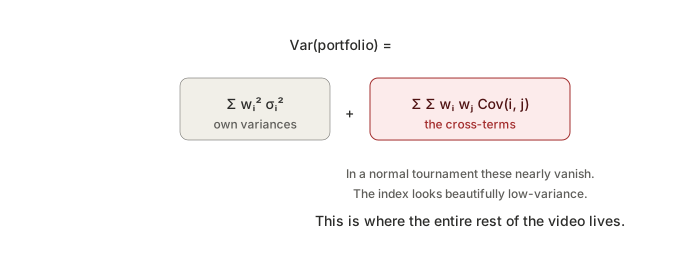
national footballing competence. The portfolio math is the ordinary kind — a weighted sum
of variances, plus the cross-terms, every pairwise covariance between the constituents.
Var(portfolio) decompositionFIG
The cross-terms are printed in red because the entire rest of this page
lives inside them.
In a normal tournament the cross-terms are nearly zero. Brazil winning its group in one
city has little to do with Morocco winning its group four time zones away. The games look
independent, the covariances vanish, and the basket feels safe.
File that feeling of safety. It is the exact feeling that was
mispriced in 2007.
§ IV — Layer two
The tranche, or: how to turn 48 soccer games into a CDO
Different buyers want different risk, and traditional finance solved that with a
waterfall: pool the cashflows, then pay them out in strict order of seniority. The equity
tranche eats the first upsets and collects the fattest yield — these are the degenerates,
and they know it, and they are being paid for it. The mezzanine sits above them, untouched
until the equity buffer is gone. The senior tranche sits on top and only loses if the
upsets chew through everyone below it, which, in a normal tournament, essentially never
happens. So it pays a low yield and is marketed — sold, believed — to be safe.
You have just built a collateralized debt obligation out of the World Cup. The obligors
are national teams. A default is an upset. Recovery is zero. The attachment points are
contract parameters. And the senior tranche is safe for exactly as long as the upsets stay
uncorrelated.
CDO waterfall · loss attributionLIVE
DRAGDrag the upset count. Watch who bleeds, and in
what order.
If favorites fail independently — one here, one there, scattered randomly across the
bracket — the total number of upsets clusters tightly around its expected value, the junior
buffer absorbs them, and the senior tranche is genuinely money-good. Sums of independent
variables concentrate; the probability of many simultaneous failures is a product of many
small numbers. But if some single factor causes many favorites to fail at once,
the distribution grows a fat upper tail, and the tail goes straight through the equity,
through the mezzanine, and into the tranche everyone was told was safe.
K distribution · independent vs correlatedLIVE
Same average. Same teams. The only thing that changed is the correlation —
and the tail is where the senior tranche lives. The mean barely moved. The tail ate
everything. (This chart is also a complete history of 2008.)
The senior tranches of subprime CDOs were rated AAA on models that assumed mortgage
defaults in Florida were roughly independent of defaults in Nevada. They shared a common
factor. When it turned, correlation went to one, the tail the models said was empty turned
out to be where all the mass was, and "safe" went from par to pennies. The instrument
didn't lie. The correlation assumption did.
§ V — The common factor
Why this World Cup's correlation structure is uniquely radioactive
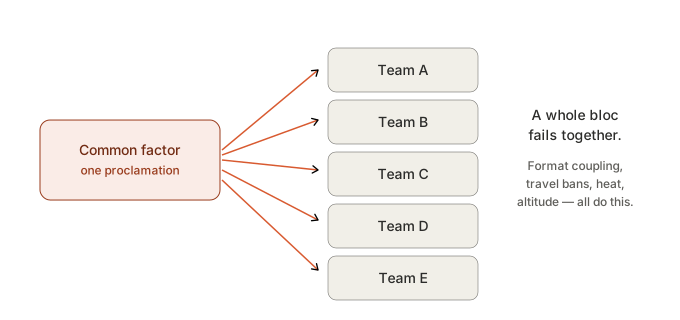
So everything depends on one question: what could make a dozen favorites fail at once?
In most years, nothing — football is noisy and local, and independence is a decent
approximation. A World Cup CDO in 2014 would have been a boring, well-behaved product.
2026 is not most years. 2026 has common factors, they are not hypothetical, and they are
in the news today.
FACTOR 01 — THE RULEBOOK
The eight-best-thirds rule wires all twelve groups together: a flurry of
high-scoring results in Group H can eliminate a third-place team from Group C that did
nothing differently. Cross-group dependency is not a risk to this format. It is in the
regulations.
FACTOR 02 — THE BORDER
This is the World Cup of the travel ban. Multiple qualified nations sit under entry
restrictions that have already delayed players, officials, and entire fan bases. One
proclamation does not hit one team; it hits every team from an entire political bloc
at once. One event, many correlated failures. It is the housing market of this CDO.
FACTOR 03 — THE MAP
Three countries, sixteen venues, Mexico City at 2,240 meters. Heat protocols,
altitude, time-zone whiplash — shared shocks across whole swaths of the bracket.
Independence assumes each team draws its fate from a private urn. 2026 makes them
share the urn, and the urn is being shaken by Washington.
common factor → correlated defaultsFIG
The anatomy of a common factor: one event, many simultaneous "defaults."
Relabel the left box with whichever of the three you find most plausible. The math does
not care which one you pick.
The senior tranche of the World Cup CDO is short exactly this: a correlation spike that
can arrive on the strength of a press release. It is short correlation, and it doesn't
know it. Which raises the question of who sells it the protection it needs.
§ VI — Layer three
The synthetic VIX, or: volatility as a tradeable asset
Now stop watching prices and start watching how violently they move. Sum the squared
price changes across the basket — every upset, every VAR reversal in the 89th minute,
every favorite suddenly on the brink — and you have a live, continuously observable index
of how much chaos the tournament is producing. Package it as a token and you have built a
volatility index on a soccer tournament. A Sports VIX. (You said you'd remember the shape
from § II. This is where you buy it.)
Why is this more than a casino game with a Greek letter painted on it? Because the
equity VIX is useful for exactly one reason: it spikes precisely when the market craters,
so long volatility offsets long equity by construction. And our version has the same
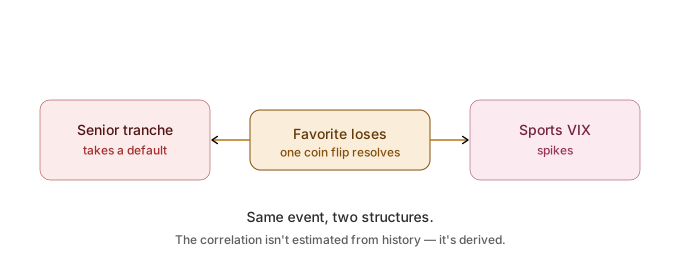
property, mechanically. The event that does maximum damage to the senior tranche — a wave
of correlated upsets — is a cluster of contracts violently repricing from near-one to
zero, which is the same physical event that sends realized variance through the
roof. The hedge isn't statistical. It's mechanical. Same coin flips, two functions.
senior tranche ⟷ variance tokenFIG
Sell the senior tranche to the pension-brained buyer; hold the variance token
against it. Calm tournament: the tranche pays, the token decays, you earn carry.
Meltdown: the tranche bleeds, the token explodes, you're covered.
§ VII — Layer four
The correlation note: the instrument that pays when the world stops being independent
One instrument left, and it's the sharp one: a contract that doesn't bet on upsets, or
on chaos, but on whether bad things happen together. Take the twelve favorites'
entry prices. If the games are independent, the number of upsets K follows a distribution
you can compute exactly from those prices — the Poisson–binomial, mean Σ(1−pᵢ), variance
Σpᵢ(1−pᵢ), no model, no history, nothing to argue about. Set a threshold K* at its 95th
percentile and write the contract: pays $1 if K ≥ K*.
Under true independence this resolves Yes almost exactly 5% of the time, by
construction, and should trade near five cents. It pays off dramatically more often than
that under exactly one condition: the upsets are positively correlated. You are not
betting on upsets. You are not betting on volatility. You are betting that the
independence assumption breaks.
Poisson–binomial · P(K ≥ K*)LIVE
DRAGDrag the correlation. Watch the 5% tail get
fat. The crowd prices the left curve. The bracket is the right one.
This is, precisely and without exaggeration, the instrument that
everyone who was short correlation in 2007 wished they had owned in 2008. The senior
tranche above is short it and doesn't know it. That was also true last time.
And the alpha lives in one place: the five-cent baseline is only fair if the games are
actually independent when you strike the contract. If a common factor is already visible —
the travel-ban news is already breaking, three southern venues are already forecast for
40°C — then the true probability of K ≥ K* is far above 5%, and the contract is mispriced
at birth by everyone who computed the lazy independent baseline. The crowd prices the
bracket as 48 independent coin flips. It isn't. It never was. In 2026 least of all.
§ VIII — The inversion
Yes, we noticed
At this point you have noticed that we have reconstructed, instrument for instrument,
the architecture that brought the global financial system to its knees eighteen years ago,
and you may be wondering whether we are aware of this. We are. It's load-bearing.
Here is the comparison, stated as mechanics rather than morals:
2008
RBS
Collateral
American real estate (historically the safest asset on Earth)
Sports gambling (self-explanatory)
Collateralization
Fractional, leveraged ~30:1, rehypothecated
100%, on-chain, one dollar locked per contract
Where the risk sits
Discoverable years later, in court
A block explorer, now
Worst case
Global financial collapse, $700B bailout
Some tokens about soccer go to zero
The correlation assumption
Hidden inside a Gaussian copula nobody read
Printed on the front of this page, in § IV, with a slider
The 2008 complex failed because the safest collateral in history turned out to have a
common factor, and the structure around it was leveraged, opaque, and systemic, so the
surprise was fatal. This complex starts from collateral nobody would dream of calling
safe, funds every position in full, and publishes its one fatal assumption as the
centerpiece of its own marketing. We are not claiming this says something reassuring
about us. We are noting that it says something extremely uncomfortable about 2008.
§ IX — The stack
The part where it stops being a metaphor
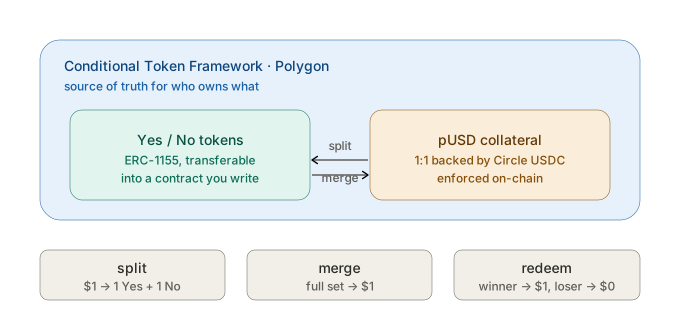
Everything above would be a creative-writing exercise except for one technical fact: a
position on the largest prediction market is a standard token, on a public chain, in a
wallet you control, fully collateralized one-to-one by a regulated stablecoin — and as of
two months ago, the exchange lets smart contracts trade it directly. The plumbing for
"a contract that holds and trades prediction-market positions" already shipped. We didn't
build the rails. We just read the documentation.
on-chain substrate · CTF / pUSDFIG
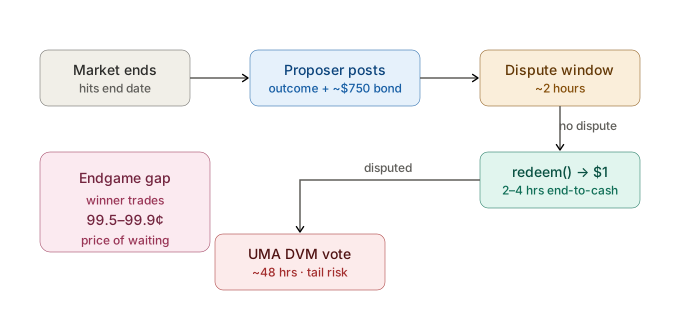
Outcomes resolve through an optimistic oracle: a proposer posts the result with a bond,
a dispute window opens, and if nobody objects, winning tokens redeem for a dollar a few
hours after the final whistle. In the gap between "mathematically decided" and
"redeemable," winning shares trade at 99.5 to 99.9 cents — the missing fraction is the
market pricing the cost of waiting for certainty, visible in the order book. Even the
boring plumbing here generates a yield curve.
optimistic oracle · resolution flowFIG
The build order is the order you just read. Each module is independently useful, and
each one is a real product even if the next never ships:
Module
What it is
Status
pm-core
Custody & read layer — prove the token moves
IN VALIDATION
pm-index
The basket — an ETF on footballing competence
SPECIFIED
pm-tranche
The waterfall — yes, that waterfall
SPECIFIED
pm-vix
Realized chaos, tokenized
SPECIFIED
pm-corr
The keystone — pays when independence dies
SPECIFIED
Nothing in the stack is about soccer. The instruments require exactly one
thing from their underlying: binary contracts that resolve through a trusted oracle.
Elections qualify. Fed decisions qualify. Rocket launches qualify. The World Cup is simply
the loudest possible place to plant the flag — the first underlying, not the last. Hence
the name.
§ X — The decision
Satire or spec?
The teams are real, the contracts are real, the oracle is real, the $1.6 billion is
real, the math is exact, and every component compiles. The only thing that decides which
one it is, is whether someone builds it. The tournament starts in
—. We have to decide too.
The waitlist
Confirmed. Your position is fully collateralized.
Be notified when the stack goes live. Or when it doesn't. Either way,
you'll want to have been on this list.
Reality-Backed Securities is brought to you by
Jaime Rogozinski, who previously brought you WallStreetBets, and who notes
that the last thing he built also started as a joke.